If you've ever tried to track food in Australia using a mainstream app, you'll know the specific friction. The packet says 1,450 kJ. The app wants calories. The database entry is for an American product with an American serving size. Somewhere in the middle you do arithmetic you shouldn't have to, and eventually you stop bothering.
Australian food labels are legally required to show energy in kilojoules, and the reference figure on every large chain menu board is 8,700 kJ — about 2,080 calories for an average adult. To convert, divide kJ by 4.2 for calories, or just divide by 4 for a quick estimate. Most tracking apps default to US calories and US serving sizes, so the practical move is to set your app to kJ and work in the same unit as the label in front of you.
None of the big trackers were built here, and it shows. Here's how the Australian system actually works, and how to track inside it without fighting your own food labels.
#Australia runs on kilojoules, by law
Australia adopted the metric system in the 1970s, and since the joule is the international unit for energy, it became the standard for food labelling under the Food Standards Code. Every packaged product sold here must list energy in kilojoules per 100g — or per 100ml for liquids — as well as per serving.
That per-100g column is the most useful number on the packet and the most ignored. It's standardised by law, which means it's the only figure you can compare directly across two products. Serving sizes, by contrast, are set by the manufacturer and vary considerably.
#The conversion, and the shortcut
One calorie is about 4.184 kilojoules. So:
- kJ to calories: divide by 4.184 (or just by 4 for a quick estimate)
- Calories to kJ: multiply by 4.184
The "rule of 4" is what most people actually use in the aisle. It overestimates calories slightly, by around 4%, which is well inside the error of everything else in food tracking.
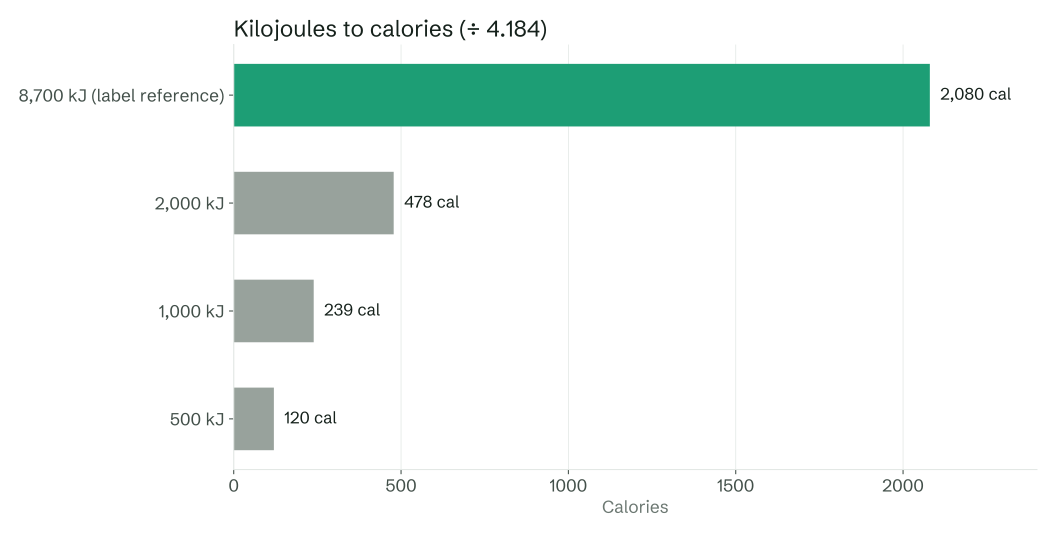
Some worked conversions:
| Kilojoules | Calories | What it is |
|---|---|---|
| 8,700 kJ | 2,080 | Labelling reference for an average adult day |
| 2,000 kJ | 478 | Roughly the daily deficit for ~0.5kg/week loss |
| 1,000 kJ | 239 | A pint of full-strength beer |
| 500 kJ | 120 | A pot of beer, or a medium banana and an apple |
#What 8,700 kJ actually means
You'll have seen the line in small print at the bottom of menu boards: "The average adult daily energy intake is 8,700 kJ." That's not decoration — it's a legal requirement.
The menu labelling rule
Large chain food businesses in most Australian states and territories must display the average kilojoule content of each standard menu item, alongside the reference statement that the average adult daily energy intake is 8,700 kJ. The requirement covers menu boards, drive-through boards, printed menus, online ordering and mobile apps. Source: state and territory food regulations implementing the kilojoule menu labelling scheme.
The point of the 8,700 figure is comparison. If a burger is 3,180 kJ, that's about 37% of the reference day in one item — which is a far more useful thing to know than the raw number.
Two caveats worth holding onto. First, 8,700 kJ is a labelling reference for an average adult, not a target for you. Your actual requirement depends on your size, age, sex and activity — a very active teenager might need 12,000 kJ while a sedentary older adult needs considerably less. Second, it's a maintenance figure, not a weight loss one.
#Losing weight in kilojoules
The arithmetic is the same as anywhere; only the unit changes. A deficit of around 2,000 to 2,500 kJ per day below maintenance is commonly cited as producing roughly half a kilogram of loss per week. For many Australian adults that lands somewhere between 5,500 and 7,000 kJ a day, though it varies a lot with body size and activity.
Intakes below about 3,500 kJ per day shouldn't be attempted without medical supervision. And if you want a number that's actually yours rather than an average, a GP or an Accredited Practising Dietitian is the right place to get it.
#Where the apps fall down here
Three specific problems, all of them fixable.
Unit mismatch. The app shows calories, the packet shows kilojoules, and you convert in your head several times a day. Most apps let you switch the display to kJ in settings, and almost nobody does. It's the single highest-value setting change for an Australian user — it means the number you read is the number you enter.
Database mismatch. Search a global database for a common Australian product and you'll often get an American equivalent with a different formulation and a different serving size. Our biscuits, spreads, breads and dairy aren't the same products, and generic entries assume US conventions.
Serving size mismatch. This one is subtle and does real damage. A US entry might assume a serving that bears no relation to what's on your plate. When the database entry and the packet disagree, work from the per-100g column — it's the only figure that's legally standardised.
#Drinks are their own problem
Australian beer glassware is genuinely the most confusing in the English-speaking world, and it defeats database-driven tracking outright. A schooner in Sydney is 425ml. The same word in Adelaide gets you 285ml. A pint in Brisbane is 570ml; in Adelaide it's 425ml.
So an app entry labelled "1 pint of beer" can be wrong by 25% depending on which state you're standing in, before anyone has estimated anything. Roughly, all at full strength:
| Name | Volume | Approx. kJ |
|---|---|---|
| Pot (VIC, QLD, TAS) / middy (NSW, WA) | 285ml | 500 |
| Schooner (NSW, QLD, VIC) | 425ml | 750 |
| Schooner (SA) | 285ml | 500 |
| Pint (most states) | 570ml | 1,000 |
| Pint (SA) | 425ml | 750 |
| Jug | 1,140ml | 2,000 |
Built in Australia, for the way you actually eat.
Say what you ate in plain words — schooners, snags, a serve of chips. Rekkon estimates it, in kilojoules or calories.
Try Rekkon free#The Australian Guide to Healthy Eating
Worth knowing about, because it's the official framework and it takes a different approach entirely. Published by the NHMRC, the AGHE is a plate divided into five food groups by area, with vegetables and grain foods taking the largest shares, followed by fruit, dairy and alternatives, and lean meats and alternatives.
It deals in serves rather than energy — a serve of vegetables, a serve of dairy. That's a deliberate choice: for a lot of people, hitting food group targets is more useful and more sustainable than counting energy at all. If numbers aren't working for you, the AGHE is a legitimate alternative rather than a lesser one.
#A practical setup
If you're tracking in Australia, this is roughly the shortest path to something that works:
- Switch your app to kilojoules. Same unit as every label you'll read.
- Learn your maintenance in kJ, not calories, so you never convert.
- Use the per-100g column when a database entry and a packet disagree.
- Log drinks separately, by volume rather than by the name on the menu.
- Pick an app built here. There are six Australian-built trackers, all in kilojoules — the guide compares them honestly, ours included.
- Don't fight the database for local foods. If your app can't find a Vegemite serve or a Coles roast chook, describing it is faster than hunting for an entry that doesn't exist.
That last point is the reason voice logging suits an Australian user particularly well. "Two Weet-Bix with milk" or "half a barbecue chook and a serve of chips" doesn't require a database to contain those exact products — it just needs to understand what you said. Which is a smaller problem than maintaining an Australian food database, and a lot smaller than asking you to do unit conversion at breakfast.
#Common questions
How do I convert kilojoules to calories?
Divide kilojoules by 4.184 to get calories — one calorie equals about 4.184 kJ. For a quick estimate in the supermarket aisle, dividing by 4 is close enough. So 8,700 kJ is roughly 2,080 calories, and a 2,000 kJ meal is about 478 calories. Going the other way, multiply calories by 4.2.
What is 8,700 kJ and why is it on every menu?
It's the reference average adult daily energy intake used across Australian food labelling. Large chain food businesses are legally required to display the statement 'The average adult daily energy intake is 8,700 kJ' alongside the kilojoule content of standard menu items, so people can judge one item against a whole day. It's a labelling benchmark, not a personal target — your actual needs depend on your size, age and activity.
How many kilojoules should I eat to lose weight?
A deficit of roughly 2,000 to 2,500 kJ per day below your maintenance level is commonly cited as producing around half a kilogram of loss per week. For many Australian adults that means somewhere in the 5,500 to 7,000 kJ range, but it depends heavily on your size and activity. Very low intakes below 3,500 kJ a day should only be followed under medical supervision. Speak to a GP or an Accredited Practising Dietitian for a personal number.
Why do nutrition apps use calories when Australia uses kilojoules?
Most of the major tracking apps were built in the United States, where calories are the standard unit and serving sizes follow American conventions. Many let you switch the display to kilojoules in settings, which is worth doing — it means the number on the packet and the number in the app are the same unit, with no mental arithmetic and no conversion errors.
Are Australian serving sizes different from American ones?
Often, yes, and it causes real tracking errors. Australian labels give energy per 100g as well as per serving, and manufacturers set their own serving sizes. A US database entry for a similar product may assume a different portion entirely. When in doubt, work from the per-100g column on the label, which is standardised by law.