Ask the internet how much protein to eat on a GLP-1 and you will get a number. Ask it twice and you will get a different one. The published answers range from about 1.0 to 2.2 grams per kilogram — and they are not even measuring the same kilogram.
Current GLP-1 consensus guidance lands at roughly 1.2 to 1.5 grams of protein per kilogram of actual body weight per day during active weight loss — about 108–135g for a 90kg person. Higher figures you'll see quoted (1.6–2.2 g/kg) come from the general weight-loss literature, and some sources quietly switch the denominator to goal weight or lean mass. The bigger problem isn't the target: in one cohort of current users, only 43% were reaching even the 1.2 g/kg minimum.
That is not a small discrepancy. For a 90kg person it is the difference between 90 grams a day and roughly 200. One of those is a normal amount of food. The other is a part-time job.
This piece does something the ranking pages mostly don't: it explains why the numbers disagree, what the actual consensus documents say, and why the target you pick matters less than whether you have any idea if you're hitting it.
#The numbers, side by side
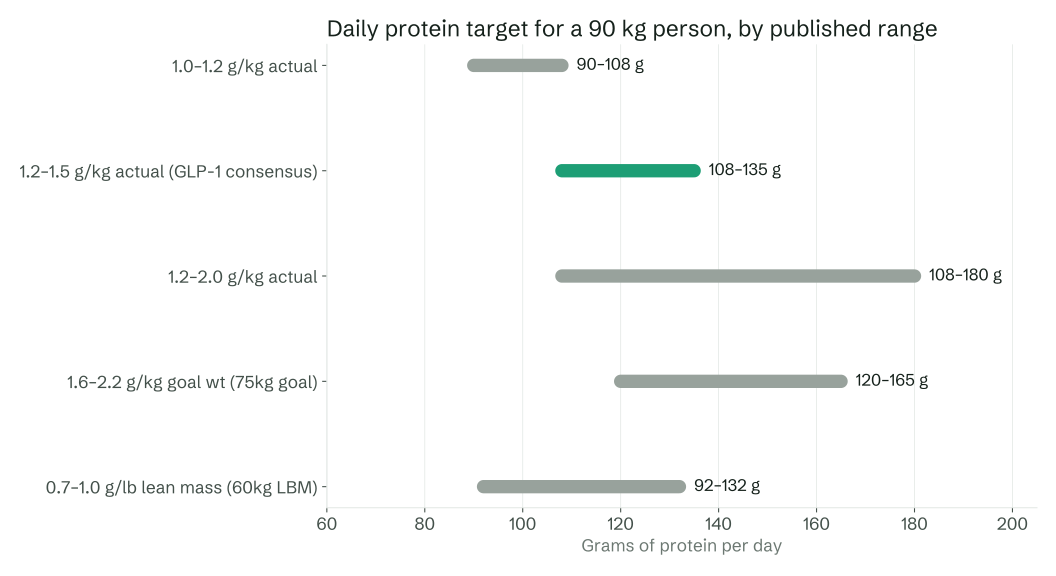
Here is the spread you'll find across widely-cited sources, with the denominator each one uses:
| Range | Denominator | Where it comes from |
|---|---|---|
| 1.0–1.2 g/kg | Actual body weight | Low end; common on telehealth prescriber sites |
| 1.2–1.5 g/kg | Actual body weight | GLP-1 consensus guidance during active weight loss |
| 1.2–2.0 g/kg | Actual body weight | Clinical nutrition literature, “desirable” range |
| 1.6–2.2 g/kg | Goal body weight | General weight-loss and sports nutrition literature |
| 0.7–1.0 g/lb | Lean body mass | Requires a body composition scan to apply |
Four denominators, a twofold spread in the multiplier. No wonder people give up and guess.
#Why the sources disagree
There are two separate reasons, and they compound.
The denominator problem. Protein targets were originally developed in populations without obesity, where body weight and lean mass track together reasonably well. In someone carrying substantial excess fat, actual body weight inflates the target — fat tissue doesn't require protein to maintain. So clinicians reach for workarounds: goal weight, adjusted body weight, or lean mass. Each workaround produces a defensible number. They just aren't interchangeable, and almost nobody states which one they're using.
The evidence problem. This one is more uncomfortable. The trials that established how well these drugs work largely did not measure what people ate.
The gap in the evidence base
A 2026 systematic review found that only two of 41 randomised controlled trials prescribing liraglutide, semaglutide or tirzepatide reported or assessed dietary change. A 2025 scoping review found that only 10 of 129 injectable anti-obesity medication trials reported diet intake outcomes at all. Source: Metabolites, 2026, narrative review on lean mass and musculoskeletal preservation in GLP-1-based obesity treatment.
So when a website confidently gives you a GLP-1 protein target, it is almost always extrapolating from the general weight-loss, older-adult or sarcopenia literature. That extrapolation is reasonable. It is not the same as direct evidence, and the honest sources say so.
#What the consensus documents actually say
Strip out the content marketing and the picture is more settled than the spread suggests. Current GLP-1 consensus guidance recommends individualised higher-protein eating at roughly 1.2 to 1.5 grams per kilogram of actual body weight per day during active weight loss.
That figure has support behind it. Meta-analytic evidence from weight-loss interventions in adults with overweight or obesity indicates that higher protein intake attenuates muscle mass loss, with intakes above about 1.3 g/kg/day associated with better preservation than lower intakes.
So: for a 90kg person, roughly 108 to 135 grams a day. For a 70kg person, roughly 84 to 105. If you have kidney disease, this conversation belongs with your doctor rather than a blog.
The higher figures aren't wrong so much as borrowed — they come from contexts (resistance-trained athletes, aggressive cutting phases) that don't describe most people on a weight-loss injection.
#The number that matters more than your target
Here is the statistic that reframes the entire question. In a cross-sectional study of current GLP-1 receptor agonist users, mean protein intake was 77.3 grams per day — against estimated requirements spanning 74 to 169 grams across participants. Only 43% were reaching even the minimum 1.2 g/kg/day.
Read that again. Well over half of people on these medications are not hitting the floor, let alone an optimised target.
Which means the argument about whether the right answer is 1.2 or 1.6 or 2.2 is, for most people, entirely academic. You are not choosing between good and optimal. You are somewhere below the floor, and the gap between where you are and 1.2 is much larger than the gap between 1.2 and 2.2.
#Why hitting it is structurally hard
This is not a discipline problem, and framing it as one is both wrong and unhelpful. The medication works by suppressing appetite. Reported reductions in energy intake range from about 16% to 39%. When total food intake falls that far and nobody is actively counselling you on composition, protein falls along with everything else.
Three things make it worse:
Gastrointestinal symptoms narrow what you can tolerate. In one cohort of current users, 53.7% reported nausea, 30.3% fatigue and 27.8% diarrhoea. Meat and heavy foods are frequently among the first things that become unappealing — and they're the protein-dense ones.
Protein ends up bunched at night. In a secondary analysis of that same cohort, roughly 40% of daily protein was eaten at dinner. Low appetite pushes people toward a single larger evening meal, which is the least useful distribution: spreading protein across eating occasions makes it more likely each one reaches a threshold where it can be used for muscle.
Almost nobody gets professional support. Only 20% of users in that study reported being referred to a registered dietitian. Just 51% reported receiving any information about managing gastrointestinal side effects at all.
The finding that fewer than half of users reach the minimum target, despite that minimum being consensus guidance, reflects a structural difficulty inherent to the treatment — not a lack of awareness.
#What actually helps
The practical measures that appear consistently across current clinical guidance are unglamorous and mostly about sequencing:
- Protein first, literally. Start each meal with the protein component before vegetables or starch. When you fill up after a few bites, the order you eat in decides what you got.
- Move protein earlier in the day. If 40% of your protein is arriving at dinner, breakfast is the highest-leverage meal to change.
- Use liquid or semi-solid sources during titration. Dose-escalation weeks are when solid food tolerance is lowest. Greek yoghurt, skyr, milk-based drinks and soups are easier to get down than chicken breast.
- Add resistance training, two to three sessions a week. This is the one co-intervention with randomised support: in the liraglutide-plus-exercise maintenance trial, exercise-containing arms preserved bone mineral density substantially better than medication alone, and improved stair-climb performance by close to 9% over pharmacotherapy alone. Protein and loading work together; neither substitutes for the other.
- Watch more than protein. The same reduced intake that lowers protein also lowers fibre, calcium, iron and vitamin D. In a retrospective analysis of 461,382 adults with type 2 diabetes newly prescribed these medications, diagnosed nutritional deficiencies occurred in 12.7% within six months and 22.4% within twelve.
#The part nobody addresses: how would you know?
Every article on this topic ends at "prioritise protein." None of them answer the obvious follow-up.
You ate half a chicken thigh and some yoghurt, felt full, and stopped. Was that 30 grams or 12? Across a day of small, irregular, appetite-suppressed eating, the error compounds fast — and the 43% figure exists precisely because people believe they're doing fine when they aren't.
This is a measurement problem, and it's the one traditional food logging handles worst. Database-search apps assume discrete meals at normal times in normal amounts. GLP-1 eating is the opposite: four bites at 11am, half a portion at 2pm, a yoghurt before bed. Logging each of those through a search screen costs two to four minutes a go, which is exactly the friction that makes people stop tracking within a fortnight.
Protein at every meal. We'll do the maths.
Say what you ate — even if it was four bites. Rekkon estimates the protein and tracks whether you're actually hitting your target.
Try Rekkon freeVoice logging exists for this shape of problem. You say "half a chicken thigh and a small greek yoghurt" and get an estimate in about five seconds, without opening a database. The estimate is directional rather than laboratory-grade — but directional and actually recorded beats precise and abandoned, and knowing you landed near 70g when you were aiming for 120g is the information that changes what you do tomorrow.
#If you stop the medication
Worth knowing while you're building the habit rather than after. A 2026 systematic review and meta-analysis of 37 studies covering more than 9,300 people found that people regained a mean of 0.4kg per month after discontinuation, tracking toward baseline weight within roughly 1.7 years. Regain was faster after stopping medication than after stopping behavioural interventions alone.
The reading of that isn't "never stop." It's that pharmacotherapy without integrated nutritional and behavioural support produces a more fragile result. The protein habit, the resistance training and the awareness of what you're actually eating are the parts that stay with you when the prescription doesn't.
#Common questions
How much protein should I eat on Ozempic or Mounjaro?
Current GLP-1 consensus guidance converges on roughly 1.2 to 1.5 grams of protein per kilogram of your actual body weight per day during active weight loss. For a 90kg person that's about 108 to 135 grams. Higher figures you'll see quoted — 1.6 to 2.2g/kg — come from the general weight-loss and sports nutrition literature rather than GLP-1-specific guidance. Talk to your prescriber or a dietitian about your own target, particularly if you have kidney disease.
Why do different websites give completely different protein numbers?
Two reasons. First, they use different denominators: some calculate from your actual body weight, some from your goal weight, some from your lean body mass. The same person can get 90g or 200g depending on which is used. Second, the direct evidence is thin. A 2026 systematic review found only two of 41 randomised trials prescribing these medications reported or assessed dietary change at all, so most guidance is extrapolated from non-GLP-1 weight loss research.
Do GLP-1 medications cause muscle loss?
They cause lean mass loss, which is not quite the same thing. In the SURMOUNT-1 DXA substudy, roughly three-quarters of weight lost on tirzepatide was fat and one-quarter was lean soft tissue. That ratio is broadly comparable to other effective weight-loss methods. DXA-derived lean mass also includes water, organs and connective tissue, so a decline in it doesn't automatically mean skeletal muscle wasting — and trials show lean mass can fall while strength and physical performance improve.
Why is it so hard to eat enough protein on a GLP-1?
Because the medication works by making you want to eat less. Reported reductions in energy intake range from about 16% to 39%, and gastrointestinal symptoms are common — in one cohort of current users, 53.7% reported nausea. When total intake falls and no one is actively counselling you on protein, protein falls with everything else. In that same cohort, only 43% were reaching even 1.2g/kg per day.
Should I use protein shakes on a GLP-1?
Consensus guidance is food-first, with supplements reserved for people who can't reach their target through food alone. That describes a lot of GLP-1 users, particularly during dose escalation when solid food tolerance is lowest — liquid and semi-solid protein sources are a practical option in that window. There is no direct randomised evidence yet on protein supplementation specifically during GLP-1 therapy; a registered trial is expected to report around 2027.