Look at almost any food tracking app after a Saturday night and you'll see the same thing: a carefully logged breakfast, a reasonable lunch, dinner entered in detail — and nothing at all from 6pm onward except the meal.
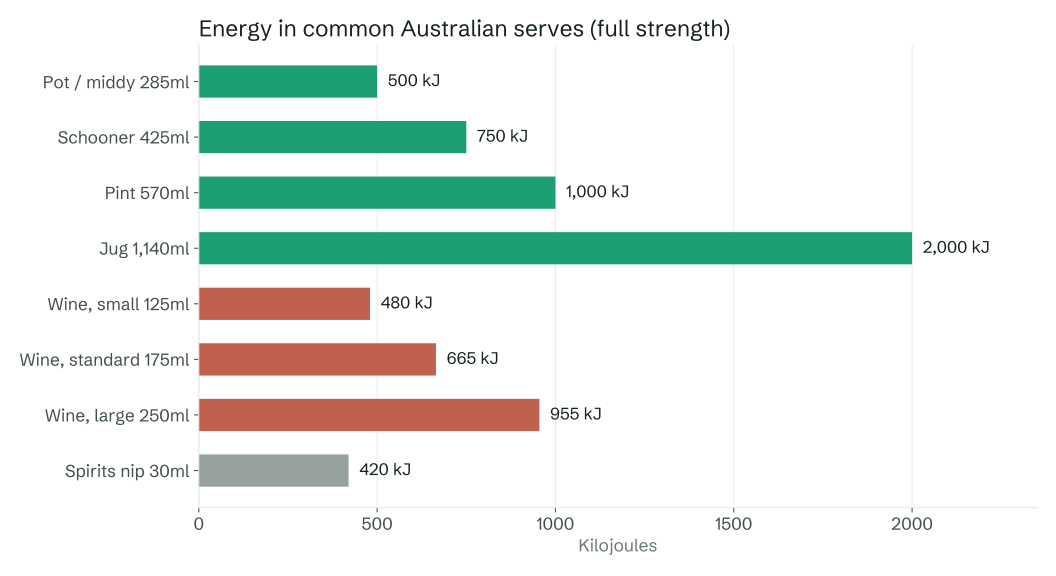
A standard 425ml schooner of full-strength beer is roughly 750 kJ (180 calories), a pint about 1,000 kJ, and a large 250ml glass of wine around 228 calories. Four drinks on a Friday is comfortably 800–1,000 calories before you've eaten. Drinks get missed because they don't feel like food, they're rarely logged in the moment, and more than 80% of people underestimate what's in a large wine. The fix isn't abstinence — it's counting them as their own line item.
The drinks are missing. Not because people are being dishonest, but because alcohol occupies a strange category in most people's heads. It isn't food. It doesn't feel like eating. And by the third one, logging is not what anybody is thinking about.
This is the single largest blind spot in food tracking, and it's the one most articles tiptoe around.
#How badly people misjudge it
The research on this is blunt.
What people think is in a drink
A Royal Society for Public Health survey found that more than 80% of people either did not know or underestimated the number of calories in a large glass of wine, and more than 60% did the same for a pint of lager. Source: Royal Society for Public Health, public awareness survey on alcohol and calorie content.
That's not a rounding error across the population. It means the majority of people drinking are working from a number that's meaningfully wrong, in a predictable direction.
#The actual numbers
Australian serves, because that's what most people reading this are holding:
| Drink | Serve | Approx. kJ | Approx. cal |
|---|---|---|---|
| Beer, pot / middy | 285ml, 4.8% | 500 | 120 |
| Beer, schooner | 425ml, 4.8% | 750 | 180 |
| Beer, pint | 570ml, 4.8% | 1,000 | 240 |
| Beer, jug | 1,140ml, 4.8% | 2,000 | 480 |
| Wine, small | 125ml, 13% | 480 | 114 |
| Wine, standard | 175ml, 13% | 665 | 159 |
| Wine, large | 250ml, 13% | 955 | 228 |
| Spirits, nip (no mixer) | 30ml, 40% | 420 | 100 |
Mid-strength beer takes roughly 30% off those beer figures; light beer around half. The strength and the glass size do the work — which brand is on tap barely matters.
Four schooners is about 3,000 kJ, or 720 calories. That's a third of the day's energy for an average adult, from something most people don't log at all.
#The bit that makes it worse
Two things compound the direct calorie load, and both are well documented.
Fat oxidation pauses. When alcohol is present in the bloodstream, the liver prioritises breaking it down over oxidising stored fat. Weight loss still happens if your overall intake stays below expenditure — it's just less efficient on the days you drink.
You eat more. Research consistently finds people consume more calories from food on days they drink alcohol. Part of that is physiological, part is that inhibition around food decisions drops along with everything else. The 720 calories of beer is rarely the whole story; it's the beer plus the chips that arrived with it plus whatever happens on the way home.
Alcohol is one of the most overlooked sources of calories in the diet — not because the numbers are hidden, but because nobody thinks to look them up.
#Standard drinks aren't calorie counts
Worth separating two things that often get conflated. An Australian standard drink contains 10 grams of pure alcohol, and that's a health measure, not an energy one. NHMRC guidelines recommend healthy adults have no more than 10 standard drinks a week and no more than 4 on any one day.
The catch is that almost nothing you're actually served equals one. A schooner of full-strength beer is about 1.6 standard drinks. A pint is roughly 2.2. A restaurant pour of red wine is often 1.5 or more. "Just three pints" is over six standard drinks — above the daily guideline on its own.
So there are two separate numbers worth knowing: standard drinks for health risk, kilojoules for energy. They don't track each other neatly, because a spirit and a sugary pre-mix can carry identical alcohol with very different energy.
#Standard drinks per serve
| Serve | Standard drinks |
|---|---|
| Pot / middy, full strength (285ml) | 1.1 |
| Schooner, full strength (425ml) | 1.6 |
| Pint, full strength (570ml) | 2.2 |
| Restaurant glass of red (150ml, 13.5%) | 1.6 |
| Restaurant glass of white (150ml, 11.5%) | 1.4 |
| Bottle of red (750ml) | 8.0 |
#The naming problem
Australia has the most confusing beer glassware in the English-speaking world, and it directly undermines tracking. A schooner in Sydney is 425ml. Ask for a schooner in Adelaide and you'll get 285ml. A pint in Brisbane is 570ml; in Adelaide it's 425ml.
Which means a global app that has "1 pint of beer" in its database is, for a lot of Australians, wrong by 25% before anyone has estimated anything. If you're logging drinks, log the volume you were actually handed rather than the word on the menu.
#What actually works
1. Count drinks as their own line item. Not part of "dinner". They're a separate entry, in the same way dessert is. This one change does more than everything else combined, because the failure mode isn't bad estimation — it's no entry at all.
2. Log in one go, afterwards. Nobody logs drink three at the bar. Recording "four schooners" the next morning takes seconds and is far more accurate than the zero you'd otherwise have.
3. Know your two or three regulars. Most people drink the same handful of things. Learn what a schooner of your usual is and you never need to look it up again.
4. Watch the mixers. A nip of spirits is around 100 calories. The same nip in a full-sugar soft drink can be double that. Pre-mixed drinks are the worst offenders — high in both energy and sugar.
5. Adjust across the week, not the day. If Friday is going to be a big one, that's fine — you have seven days to work with. What matters is the weekly total, not any single evening.
Say “three schooners and a parmi”.
Drinks counted the same way as food, in about five seconds — no database, no barcode, no leaving the table.
Try Rekkon free
#One thing not to do
Don't skip meals to bank calories for drinking.
It's a common instinct and it's a bad one. Deliberately restricting food to offset alcohol is a recognised disordered eating pattern, and beyond that it's straightforwardly unsafe — drinking on an empty stomach raises blood alcohol concentration faster and increases the risk of harm on the night.
Eat normally. Count the drinks honestly. Take the adjustment across the week if you want one. If you notice yourself regularly not eating so you can drink more, that's worth raising with a GP rather than solving with an app.
#Why voice logging suits this specifically
Drinks are the worst possible case for a database-search tracker. You're standing up, usually holding something, often with other people, and the entries you'd need — "schooner, full strength, 4.8%" — don't map cleanly onto a database built around packaged products and US serving sizes.
Saying "three schooners and a chicken parmi" takes about five seconds and captures the whole evening. It won't be exact. It will be enormously closer than the nothing that currently gets recorded, and it's the difference between a weekly trend that reflects your life and one that quietly omits every Friday.
#The honest framing
None of this is an argument for drinking less, and none of it is an argument for drinking more. Plenty of people lose weight while still going to the pub — the ones who manage it are simply the ones who know roughly what it costs.
The goal isn't guilt. It's that the number in your app should reflect the week you actually had. A tracker that's accurate Monday to Thursday and blank on the weekend isn't tracking your diet; it's tracking the part of it that was easy to record.
If you're concerned about how much you're drinking rather than what it costs you in kilojoules, that's a different and more important conversation — your GP, or the Alcohol and Drug Foundation's resources, are better places to start than a nutrition app.
#Common questions
How many calories are in a schooner of beer?
A 425ml schooner of full-strength beer at around 4.8% ABV is roughly 750 kJ, or about 180 calories. A 285ml pot or middy is around 500 kJ (120 calories), a 570ml pint about 1,000 kJ (240 calories), and a jug around 2,000 kJ (480 calories). Mid-strength cuts those figures by roughly 30% and light beer by about half. Glass size and alcohol percentage drive the number far more than the brand does.
Does alcohol stop fat loss?
It doesn't stop it, but it does interfere. When alcohol is in your bloodstream your liver prioritises breaking it down over oxidising stored fat, so fat burning is temporarily paused. Weight loss still happens if your overall intake stays below what you burn — the process is just less efficient on days you drink. The larger effect for most people is simpler: the calories in the drinks themselves, plus the tendency to eat more on drinking days.
Why do people underestimate alcohol calories so badly?
A Royal Society for Public Health survey found more than 80% of people either didn't know or underestimated the calories in a large glass of wine, and more than 60% for a pint of lager. Drinks don't register as food, they're consumed in social settings where nobody is logging anything, and packaged alcohol has historically not carried the same nutrition labelling as food.
Should I skip meals to save calories for drinking?
No. Deliberately not eating to offset alcohol is a recognised disordered pattern, and it's genuinely dangerous — drinking on an empty stomach raises blood alcohol faster and increases the risk of harm. Eat normally, count the drinks as part of your intake, and adjust across the week if you want to. If you find yourself regularly restricting food to drink more, that's worth talking to a GP about.
How many standard drinks is a schooner?
In Australia one standard drink contains 10 grams of pure alcohol. A 425ml schooner of full-strength beer is about 1.6 standard drinks, a 285ml pot or middy about 1.1, and a 570ml pint roughly 2.2. NHMRC guidelines recommend healthy adults have no more than 10 standard drinks a week and no more than 4 on any one day.