Most food tracking advice quietly assumes you cook. Weigh the chicken, scan the packet, log the recipe. It works right up until Friday night, and then it doesn't work at all.
Estimate rather than search. Anchor on the protein in palm-sized units, assume more cooking fat than you can see, count drinks and sides as separate items, and log the whole meal from memory afterwards rather than at the table. Research on nearly 3,400 diners found adults underestimate restaurant meals by about 175 calories on average, with a quarter off by more than 500 — and the error grows as the plate gets bigger.
Eating out is where tracking breaks — not because the food is worse, but because every tool you've been given stops functioning. There's no barcode. The database entry for "chicken parmigiana" is somebody's guess about a different kitchen. And you're at a table with other people, which is not a great moment to start searching a food database.
#How far off the guesses actually are
The research here is unusually clear, and unusually unflattering.
What diners actually estimate
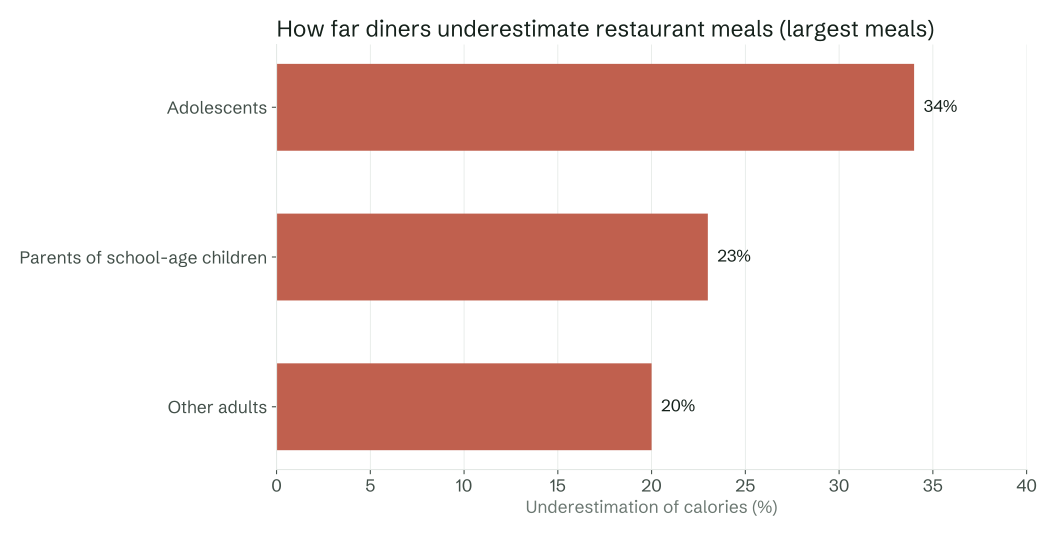
In a study of nearly 3,400 diners at fast food restaurants, adults underestimated their meal by roughly 175 calories on average and adolescents by around 260, with about a quarter of all diners off by more than 500 calories. Teenagers underestimated by as much as 34%, parents of school-age children by up to 23%, and other adults by up to 20%. Source: BMJ, cross-sectional observational study on consumer estimation of calorie content at fast food restaurants.
And this was fast food — the category where portions are most standardised and nutrition information is most available. Full-service restaurants, where nobody publishes anything and the chef decides how much oil goes in the pan, are harder.
#The bigger the plate, the bigger the miss
The error isn't a flat percentage. It scales, and not in your favour.
Research examining estimation across meal sizes found participants underestimated larger meals by 38% in one study and 22.6% in another. Estimates rise more slowly than the actual food does — your sense of "a normal plate of pasta" is anchored to the plate in front of you, not to a portion size.
That matters because restaurant portions are large almost everywhere. A multi-country analysis found 94% of full-service meals and 72% of fast food meals contained 600 calories or more — and that was measuring main courses alone, before drinks, starters or dessert.
So the two errors stack: the meal is bigger than you'd cook at home, and your estimate of it is proportionally further off than usual.
#Why the apps fail here specifically
Barcode scanning is useless — there is no barcode. Database search is worse than useless, because it delivers false precision: you find "Chicken Parmigiana, 780 cal", log it, and feel accurate. That figure came from a different restaurant, a different recipe and a different portion. It has the appearance of measurement without any of the substance.
Photo recognition apps struggle for a related reason. Identifying the dish is the easy part. Estimating how much is on the plate is the hard part, and portion estimation is consistently the weakest link in AI food recognition — which is exactly the variable that changes most between restaurants.
#Four things that work better
1. Anchor on the protein, then scale. Identify the protein and estimate it in palm-sized units. A restaurant chicken breast is usually one and a half to two palms, not one. Steak is often two to three. Get this roughly right and you've captured the largest and most variable part of the meal.
2. Assume more fat than you can see. Restaurant kitchens cook with substantially more oil and butter than home cooks, because it tastes better and they aren't paying for your macros. A reasonable working adjustment is to add a couple of tablespoons of fat to anything pan-cooked, sautéed or served with a sauce.
3. Count the perimeter separately. Bread, dressings, drinks, shared sides, the last third of someone else's dessert. These don't feel like part of "the meal", which is precisely why they go uncounted. Logging them as their own line item is the single highest-yield habit for eating out.
4. Log once, from memory, afterwards. Not at the table. The goal is a record that exists, not a live feed. Five minutes later in the car, describing the whole meal in one pass, is accurate enough and doesn't make you the person on their phone during dinner.
Say what you ordered. We'll estimate it.
No database search, no barcode, no leaving the table. Describe the meal in a sentence and get calories and macros in about five seconds.
Try Rekkon free#Menu labelling helps less than you'd hope
Where calorie counts are printed, use them — they close the information gap. But they don't close the estimation gap. You still have to decide what the number means once you've added a drink, split the chips and eaten bread while waiting. And labelling covers chains, not the independent restaurant where the portion variability is highest.
There's a subtler issue too: a printed number invites you to treat the meal as solved and stop paying attention to everything around it, which is where most of the uncounted calories live.
#The standard worth aiming for
Not accuracy. Consistency.
If you eat out three times a week and skip logging each time, you aren't tracking your diet — you're tracking the boring third of it, and then wondering why the numbers don't explain the scale. A restaurant meal estimated at 900 calories when it was really 1,100 is a 200-calorie error. The same meal not logged at all is a 1,100-calorie error.
A rough estimate you actually record beats a precise figure you never enter. This is the whole argument, and it applies to eating out more than anywhere else.
Over a few weeks, consistent rough estimates produce a trend line that tells you something true. Perfect logging on weekdays and silence on weekends produces a trend line that tells you nothing at all.
#A worked example
Pub meal: grilled barramundi, chips, salad, two glasses of wine.
Anchor on the fish — call it two palms, around 220 calories. Chips are the item people underestimate most badly; a pub serve is rarely under 400. Salad with dressing, 120. Two glasses of wine, roughly 250. Add a tablespoon of cooking fat you didn't see, 120. That's about 1,110.
You will not be exactly right. You will be considerably closer than the 650 you'd have guessed by thinking "fish and salad", and much closer than the zero you'd have recorded by not logging it.
#Common questions
How do I track calories at a restaurant?
Estimate rather than search. Identify the protein and its rough size, assume the cooking fat is higher than it looks, count the drinks and sides separately, and log it in one go. Trying to find an exact database match for a restaurant dish is usually false precision — the kitchen isn't following the recipe your app has. A quick estimate you actually record is worth more than an exact figure you never enter.
How much do people underestimate restaurant meals by?
In a BMJ study of nearly 3,400 diners at fast food restaurants, adults underestimated their meal by about 175 calories on average and teenagers by around 260, with roughly a quarter of all diners off by more than 500. Underestimation grew as meals got larger — teens underestimated by up to 34%, parents of school-age children by up to 23%, and other adults by up to 20%.
Does menu calorie labelling help?
It helps, but less than people expect. Labelling addresses the information gap, not the estimation gap — you still have to decide what a listed figure means once you've added a drink, shared some chips and had bread beforehand. It also doesn't cover most independent restaurants. Useful where available; not a solution on its own.
Should I just skip logging when I eat out?
That's the most common approach and it's the one that quietly breaks the week. If you eat out three times a week and skip logging each time, you're not tracking — you're tracking your least interesting meals. A rough estimate for the restaurant meal is far more useful than a precise figure for the porridge you ate alone at home.
What's the single biggest thing people forget to count?
Everything that isn't the main dish. Bread before the meal, cooking oil and butter you can't see, dressings, soft drink refills, a couple of glasses of wine, and a few chips off someone else's plate. None of it registers as 'the meal', so none of it gets counted — and together it can add several hundred calories.