Somewhere around day nine, everyone who has ever tracked their food has the same thought: I can't keep doing this. Not because of the number — because of the logging. The third ingredient of a stir-fry. The dressing. Whether the thing at afternoon tea was one biscuit or one and a half.
No. Complete logging isn't achievable even in research settings — around 30% of people misreport intake regardless of method, and weighing everything underestimates by about 18% anyway. Aim for consistency over completeness: a rough entry for every meal beats a precise entry for some. Two things are worth never skipping, because they're where the missing calories hide: drinks and the meals you didn't cook yourself.
So the question gets asked, usually a bit guiltily: do I actually have to log everything?
No. And the reason isn't a permission slip. It's that complete logging isn't a real thing, even in laboratories, and pretending it is has cost more people their tracking habit than any other single idea.
#Complete logging doesn't exist
Dietary researchers have spent decades trying to get accurate self-reported intake from participants who are motivated, supervised and sometimes paid. They can't.
Misreporting is the norm, not the exception
Across weighed food records, estimated records and 24-hour recalls, a British Journal of Nutrition review found around 30% of participants misreported their intake in every method, and that weighed records — the gold standard — underestimated energy by about 18%, no better than the other approaches. Source: British Journal of Nutrition, 2009.
That's the ceiling. If people with a scale and a research assistant can't produce a complete log, you aren't going to do it on a Tuesday between meetings. The goal was never achievable, which makes failing at it a poor reason to quit.
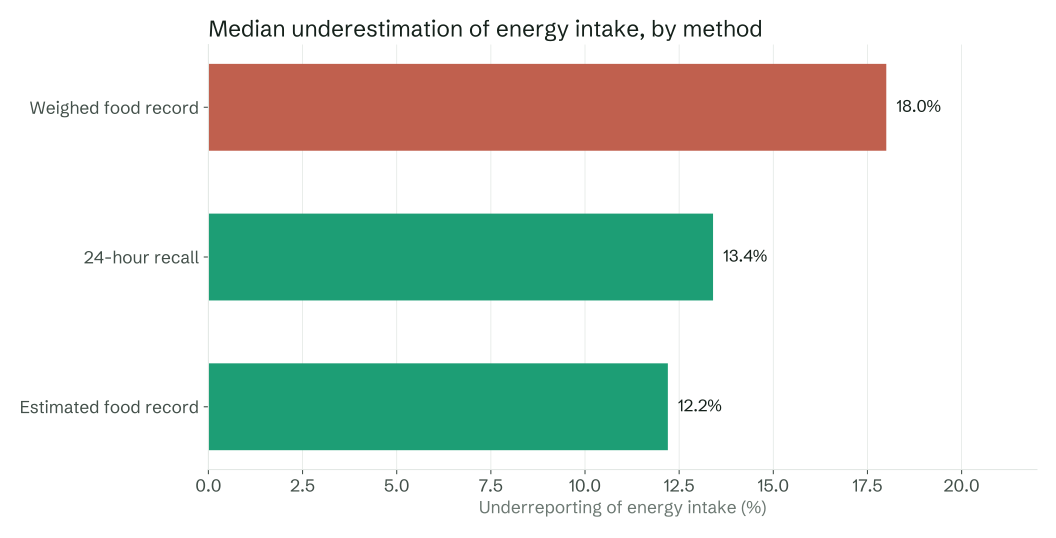
#What completeness actually costs
The real damage isn't the inaccuracy. It's the attrition.
Around 70% of people abandon a nutrition app within two weeks when logging feels time-consuming, and roughly 80% have stopped within six months. Every extra field, every ingredient breakdown, every hunt through a database for the right brand of yoghurt raises the cost of a single entry — and the cost of a single entry is what decides whether the entry happens.
There's a second, subtler cost. The British Journal of Nutrition review notes that people in weighed-record studies may not have underreported so much as under-eaten, because weighing every item is a deterrent to eating it. A method demanding enough to change your behaviour while you're using it isn't measuring your diet. It's measuring a diet you'll stop the moment you stop measuring.
A log of seven rough days tells you something true about the week. A log of four precise days tells you about the four days you found easiest to record.
#Consistency beats completeness
Here is the reframe that makes tracking survivable. Weight management responds to the weekly trend, not the daily total. A consistent 15% underestimate still produces a trend that moves in the right direction and flags the weeks that don't. What breaks the trend isn't imprecision — it's gaps, and gaps are never random.
Skipped days cluster. They're the restaurant night, the weekend, the day it all went wrong. If the days you don't log are systematically your highest-intake days, your log isn't imprecise. It's a flattering fiction, and it's why the scale and the app disagree.
So the rule: one rough entry per eating occasion, every day. Not every ingredient. Not every gram. One line that says what happened, made in the moment or shortly after, on the good days and the bad ones equally.
#The two things never to skip
If you take the rough-everything approach, two categories deserve an exception, because validation research is unanimous that they're where the missing calories hide.
Drinks. The most-forgotten category in every study. Alcohol, soft drink, juice, the flat white you didn't count because it was “just a coffee.” A recall study in the Journal of Nutrition found people reported only 71% of what they'd eaten, and the omissions skewed heavily toward small items and drinks. Log them as their own line. Alcohol particularly.
Meals you didn't cook. Restaurants, takeaway, someone else's kitchen. This is where portion estimates and hidden fats go wrong by the widest margin — and, not coincidentally, where people most often skip the entry because there's no easy database match. A rough estimate here is worth more than a precise one anywhere else.
#What you can safely let go
- Ingredient-level breakdowns. “Chicken stir-fry with rice” is enough. The estimate will be within the same error band as if you'd itemised it.
- Carbs and fat as separate targets. For weight management, total energy and protein carry nearly all the signal. The other two can float.
- Brand-level precision. Which yoghurt barely matters. That there was yoghurt does.
- Weekend guilt. A big Saturday, logged roughly, is data. A big Saturday, unlogged, is a hole in the trend that makes every other day look better than it was.
One sentence per meal. That's the whole system.
Say what you ate, roughly, every time. Rekkon does the estimating and watches the trend so you don't have to log the grams.
Try Rekkon free#Keep protein, though
One macro earns its place even in a minimal log. Protein has the strongest evidence of any nutrient for both fat loss and holding onto muscle while you lose it, and tracking it costs nothing extra if you're already describing the meal. “Chicken stir-fry” already contains the protein information; you just need the tool to surface it. Carbs and fat don't repay the same attention.
#The system, in one line
Say roughly what you ate, every time you eat, and always include the drink and anything you didn't make yourself. That's it. It's less than most apps ask for, it's more than most people sustain with those apps, and the research says it's as accurate as the version with the scale — with the one difference that you'll still be doing it in six weeks.
#Common questions
Do I really need to log every single thing I eat?
No, and trying to is the most common reason people quit. Aim for one entry per eating occasion, roughly estimated, every day. That produces a weekly trend you can act on. Chasing every last ingredient produces a beautiful Tuesday and a blank weekend, which tells you nothing about the week.
What happens if I skip a day of logging?
Nothing dramatic — one missed day barely affects a weekly average. The problem is the pattern: skipped days are almost never random. They're the restaurant nights, the weekends, the days something went sideways. If your skipped days are systematically your highest-intake days, your log is a flattering fiction. A rough entry on those days, even the next morning, is worth more than a precise one on any other.
What should I always log even if I skip other things?
Drinks and anything you didn't cook. Drinks are the most-forgotten category in every validation study — alcohol, soft drink, the second coffee. Meals from restaurants, takeaway or someone else's kitchen are where portion and fat estimates are worst. Get those two categories down every time and the rest can be rough.
Is it okay to just log calories and ignore macros?
For weight management, largely yes, with one exception: protein. Tracking protein costs nothing extra if you're describing the meal anyway, and it's the single macro with the strongest evidence for both fat loss and keeping muscle. Carbs and fat can float.
Doesn't rough logging just mean I'm lying to myself?
The research says the opposite. People with a food scale underreport by about 18% on average; people doing a spoken recall underreport by about 13%. Precision doesn't produce honesty — it produces a deterrent to eating while measured, and a log that lapses. A consistent rough estimate with a known error band is more honest than a precise log with gaps.