This is the question people ask before they download, and it deserves a better answer than the one most apps give, which is a confident number and no context.
Voice logging is accurate to roughly the same degree as every other self-report method: expect 10 to 20% underestimation of total energy, mostly from forgotten items and undersized portions. That is not worse than weighing. A British Journal of Nutrition review found weighed food records underestimated intake by 18%, against 13% for a spoken 24-hour recall — the scale doesn't fix the reporting. Voice adds a second, smaller error from AI estimation, and it's weakest on cooking fats and sauces. Its advantage is not precision; it's that the log still exists on day 40.
The honest answer has two halves. The first is that voice logging is a form of self-report, and self-report has a known, measured error rate that no consumer app escapes. The second is that the method people assume is more accurate — weighing everything — turns out not to be, once you measure it properly. Both halves matter, and the second one is the surprise.
#Every self-report method underreports
Dietary assessment research has been validating self-reported intake against objective measures for decades — doubly labelled water, controlled feeding, discreetly weighed plates. The finding is consistent and unflattering to everyone.
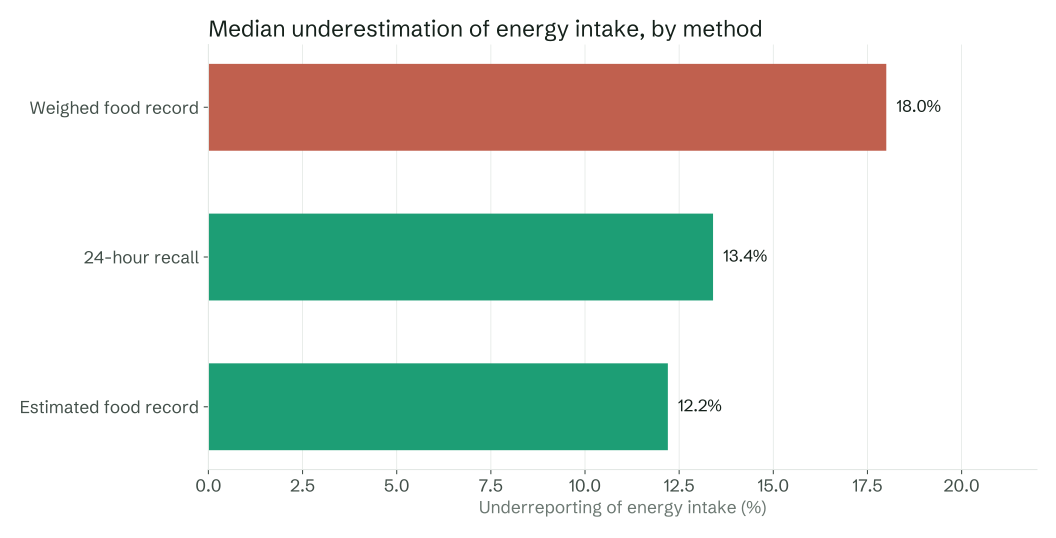
How much people underreport, by method
A British Journal of Nutrition review of validation studies found the proportion of misreporters was about 30% across all three common methods, and the median underestimation of energy intake was 18% for weighed food records, 13.4% for 24-hour recalls and 12.2% for estimated food records — with no significant difference between them. Source: British Journal of Nutrition, 2009, misreporting of energy and micronutrient intake estimated by food records and 24-hour recalls.
Read that carefully. The method with the scale underreported more, not less. Controlled-feeding work backs it up: in a Journal of the American Dietetic Association study, people underestimated their energy intake by 11 to 13% on a multiple-pass recall even when researchers knew exactly what they'd been fed.
So the question “is voice logging accurate?” is really “is voice logging accurate compared to what?” — and the comparison most people have in mind isn't as accurate as they think.
#Where the error actually comes from
Three sources, and only one of them is about measurement.
Forgetting. A 2025 validation study in the Journal of Nutrition had people eat weighed meals and then recall them the next day. Participants reported about 71% of the foods they'd actually eaten — and yet their reported energy and macros were broadly consistent with what was weighed, because they overestimated the portions of what they did remember. The omissions were disproportionately small items: drinks, condiments, the thing eaten standing up.
Portion drift. Estimates rise more slowly than the actual food does. Research on meal-size estimation finds people underestimate large meals by 20 to 38%, far more than small ones. This is the same effect that makes restaurant meals the worst-tracked category.
Behaviour change. The subtlest one. The British Journal of Nutrition review suggests participants in weighed-record studies may not have underreported so much as under-eaten — because having to weigh every item is a deterrent to eating it. A precise method that changes what you eat while you're using it isn't measuring your diet. It's measuring your diet-while-measured.
Notice that none of these are fixed by a food scale. They're fixed by remembering, by not letting the log lapse, and by the method being low-friction enough that it doesn't alter the meal.
#What voice adds, and what it doesn't fix
Voice logging has two error sources, and it's worth being precise about them.
The first is the self-report error above. Voice does nothing to remove it — if you don't mention the wine, the wine isn't counted, same as any method. What voice changes is the rate at which entries happen at all, because a five-second description gets made in situations where a two-minute database search doesn't.
The second is estimation error: converting “chicken burrito with guac and a flat white” into numbers. For common foods this is the smaller of the two errors. For unusual dishes it grows. Validation work on described-food methods (including camera-assisted recall) finds correlations with weighed intake above 0.75 for energy and macronutrients — but noticeably weaker for oils, fats, condiments and spices.
That's the specific weakness, and it's worth naming plainly: voice is least accurate on things you can't see. The oil the chicken was cooked in. The dressing. The butter on the vegetables. If you don't say it, it's undercounted — and most people don't say it.
The precision of the instrument was never the constraint. The constraint is whether an entry gets made at all, and whether the method changes the meal.


#Making it more accurate
Four things move the needle, in order of impact.
- Mention the fat. “Cooked in oil” or “with dressing” is two words and closes the biggest gap in the research.
- Log drinks as their own item. They're the most-forgotten category in every validation study. Alcohol especially.
- Say the number when you know it. A label, a menu, a scale — if you have an exact figure, say it and it's used directly. Voice isn't a replacement for known data; it's a fallback when there isn't any.
- Log the same day. Recall accuracy decays fast. Describing lunch at 9pm is better than never; describing it at 1pm is better still.
Say what you ate. Edit anything.
Rekkon estimates from your description and lets you correct it in a tap. Directional by design, so the log survives past week two.
Try Rekkon free#When directional isn't good enough
Honest boundary. If you're managing a diagnosed deficiency, following a medically supervised diet, or cutting for a competition with a weigh-in, a 10 to 20% error band isn't acceptable and a food scale plus a dietitian are the right tools. Voice logging is built for weight management and general awareness, where the weekly trend is what matters and a consistent estimate produces one.
For that use — which is most people — the research points somewhere uncomfortable for the precision argument: you were never getting the accuracy you thought you were. You were getting weighed-record accuracy on the days you weighed, and nothing on the days you didn't. A rough estimate on all seven days is a better dataset than a precise one on four, and it's the only kind that tells you something true about the week.
#What accuracy should mean
The number that decides whether a food log works isn't the error on any single entry. It's whether the log is still being kept in six weeks. Every study above measured accuracy in people who were, by definition, still recording. The 70% who abandon a tracker within a fortnight have an accuracy of zero, and no amount of database precision changes that.
Voice logging is accurate the way a bathroom scale is accurate: not to the gram, but reliably enough and easily enough that you keep using it, and the trend it produces is real.
#Common questions
How accurate is voice food logging compared to weighing food?
Comparable at the level that matters. A British Journal of Nutrition review of validation studies found around 30% of participants misreported intake regardless of method, with energy underestimated by about 18% in weighed food records, 13% in 24-hour recalls and 12% in estimated records — differences that weren't statistically significant. Weighing improves the precision of individual entries but doesn't fix the forgotten snack, the untracked weekend or the under-poured oil, which is where most of the error lives.
Where is voice logging least accurate?
Cooking fats, oils, dressings and sauces — things you can't see and rarely mention. Validation research on described-food methods finds correlations above 0.75 for energy and macronutrients but much weaker for oils, fats and condiments. If you say “grilled chicken salad” and don't mention the dressing or the oil it was cooked in, the estimate will be low. Saying it costs two extra words.
Does the AI estimate add error on top of my description?
Yes. Voice logging has two error sources: what you say (the self-report error every method shares) and how the model converts it to numbers. The second is typically the smaller of the two for common foods and larger for unusual dishes. Every estimate is editable, and if you know an exact figure — from a label, a scale, a menu — you can say it and the number is used directly.
Why does underreporting happen even with careful tracking?
Three reasons that apply to every method: people forget items, particularly drinks and small snacks; portion sizes are systematically underestimated as they get larger; and the act of precise recording changes what people eat. The British Journal of Nutrition review notes that participants in weighed-record studies may not have underreported so much as under-eaten, because weighing every item is a deterrent to eating it.
Is directional accuracy actually good enough for weight loss?
For most people, yes. Weight management responds to the weekly trend, not the daily total, and a consistent 15% underestimate still produces a trend line that moves in the right direction and flags the weeks that don't. Where it isn't enough is clinical work — managing a deficiency, a medically supervised diet, a competition cut — where a dietitian and a food scale are the right tools.