Every December the same advice comes out: skip the second helping, walk after lunch, have a glass of water between drinks. None of it is wrong, and almost none of it has been tested. A couple of things have, and one of them takes about ten seconds a day.
Weigh yourself regularly through the season and count your drinks. In a University of South Australia study, adults gained about 0.65% of their body weight, around half a kilo, between Christmas and New Year, and holiday gain tends to linger. In a UK trial, people asked to weigh themselves at least twice a week, alongside a few simple tips, didn't gain on average over Christmas; the comparison group put on 0.37 kg. Think in weeks rather than days, and keep logging, even roughly.
#How much weight do Australians gain at Christmas?
The best Australian data comes from a University of South Australia study published in JAMA Network Open in 2023. Researchers led by Carol Maher gave adults smart scales and fitness trackers and followed their weight for a year; 368 had enough data to analyse.
| Period | Average change | In grams |
|---|---|---|
| Christmas to New Year | +0.65% | about +546 g |
| Easter | +0.29% | about +244 g |
| Every week (Friday low to Monday–Tuesday high) | about 0.3% swing | about 252 g |
Two details stand out. First, summer is our heaviest season, the reverse of the northern hemisphere, where Christmas falls in winter. Australians in the study were lightest in autumn. Second, there's a weekly rhythm: lightest on Friday, heaviest on Monday and Tuesday. The Christmas break is, in effect, a fortnight of weekends.
The researchers also found that about a quarter of participants finished the year at least 2% heavier than they started, an average of 1.7 kg.
#Why half a kilo matters
Half a kilo sounds like nothing, and over one season it is. The problem is that a good part of it tends not to come back off.
In the study most often cited on this, published in the New England Journal of Medicine in 2000, 195 American adults gained an average of 0.37 kg over the holidays and didn't lose it in the months that followed. For the group tracked over a full year, the holiday period accounted for about half of their total gain.
Repeat that every year for a decade and you have the slow creep most people can't explain. It's also why the habits that protect against it look a lot like the ones the people who keep weight off long-term rely on all year.
#Where the kilojoules actually come from
Christmas Day itself is rarely the problem. One big lunch is one big lunch. It's the season around it: work parties, catch-ups, leftovers, a fridge full of ham and a bowl of chocolates on the bench, from early December to the first week of January.
The Australian Dietary Guidelines have a handy unit for this. A discretionary
serve is however much of a treat food or drink contains 600 kJ. Some Christmas-relevant examples:
| Food or drink | Amount |
|---|---|
| Wine | 200 mL (2 standard drinks; often one glass) |
| Regular beer | 400 mL (1½ standard drinks) |
| Cream | 2 tablespoons (40 g) |
| Chocolate | ½ small bar (25 g) |
| Sweet biscuits | 2–3 |
| Plain cake | 1 slice (40 g) |
| Soft drink | 1 can (375 mL) |
| Salty crackers | 30 g (a small single-serve packet) |
Source: Eat for Health (NHMRC). Now count a normal work Christmas party. Four schooners of full-strength beer is about 2,600 kJ, more than four discretionary serves, before anyone has touched the canapés. A large 250 mL glass of wine is about 770 kJ. (Full drink-by-drink figures here.)
Drinks are the biggest single variable in the season, and the one people almost never log. For health rather than kilojoules, the NHMRC guideline is no more than 10 standard drinks a week and no more than 4 on any one day for healthy adults, and a schooner of full-strength beer is about 1.6.
#What actually works
1. Weigh yourself, often. This is the one with a trial behind it. In the Winter Weight Watch Study, published in the BMJ in 2018, researchers in Birmingham randomly split 272 adults before Christmas. One group was asked to weigh themselves at least twice a week, ideally daily, and record it; they also got ten weight-management tips and a list of how much activity it takes to burn off festive food (one mince pie is about 21 minutes of running). The comparison group got a healthy-living leaflet.
By January and February the comparison group had gained 0.37 kg on average. The weighing group was down 0.13 kg. The difference, about half a kilo, is similar in size to the Christmas gain in the Australian study.
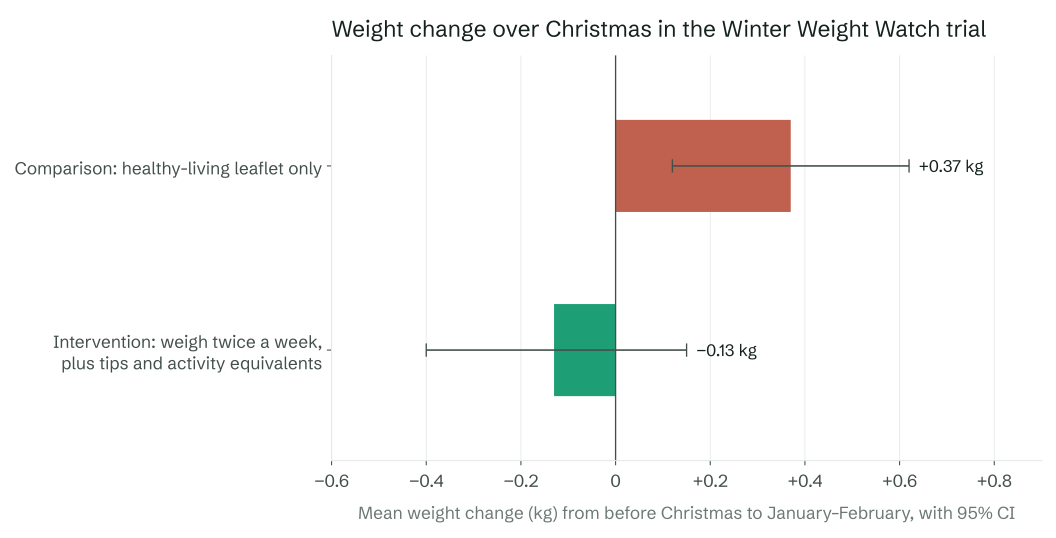
The authors couldn't separate which part did the work, so treat it as a package: weigh in, write it down, keep the season in view. Use a weekly average rather than reacting to any single morning; the weekend swing alone is a quarter of a kilo.
2. Think in weeks, not days. Christmas lunch is going to be big. That's fine. Plan the heavy days and keep the ordinary days around them ordinary, rather than writing off the whole fortnight.
3. Log the drinks, afterwards. Nobody logs drink three at the party. One line the next morning, four schooners and two glasses of bubbles
, is far closer to the truth than the zero most logs show.
4. Keep logging, roughly. If you stop tracking in December and restart in January, the gap lines up exactly with when the gain happens. A rough log of the big items beats a perfect log you've paused. (You don't have to log everything.)
5. Use the Australian advantage. A summer Christmas is unusually kind: prawns, cold ham, salads and fruit. Fill up on those first and there's less room for the third mince pie. The goal isn't avoiding Christmas food. It's avoiding six weeks of unlogged Christmas food.
Say “four schooners and a plate of prawns.”
Log the whole party the next morning in one sentence. Rekkon counts it in kilojoules and tells you what the rest of the week can look like.
Try Rekkon free
#What not to do
Don't skip meals to bank kilojoules for a party. Arriving starving makes the canapés harder to pass up, and drinking on an empty stomach is its own problem. Eat normally and count the drinks honestly.
Don't plan a January crash diet to undo it. For most people, getting back to normal meals and normal logging in the first week of January is enough. In the UniSA data, participants were on average lightest in autumn; the summer peak doesn't have to become the new baseline.
#Getting back on track in January
Expect the first weigh-in after New Year to look worse than it is. Salty, carb-heavy food holds extra water, so part of a post-Christmas jump may settle over the following days. Judge by your seven-day average, not the first morning.
Then go back to what was working. If you'd like a target, the calorie deficit calculator gives one in a couple of minutes, and a modest deficit you can hold beats a heroic one you abandon by Australia Day.
If you're worried about how much you're drinking rather than what it adds in kilojoules, that's a different and more important conversation: your GP, or the Alcohol and Drug Foundation's resources, are better places to start than a nutrition app.
#Common questions
How much weight do people gain over Christmas?
In a University of South Australia study of adults weighing themselves on smart scales, weight rose about 0.65% between Christmas and New Year, around half a kilo on average (JAMA Network Open, 2023). Studies overseas find similar amounts.
Does Christmas weight gain go away?
Often not entirely. In a US study published in the New England Journal of Medicine, adults gained an average of 0.37 kg over the holidays and had lost very little of it by the following spring. That's how small seasonal gains can add up over years.
How do I avoid gaining weight over Christmas?
The best-tested approach is regular self-weighing. In a BMJ trial, people asked to weigh themselves at least twice a week through the season, with brief tips, didn't gain weight on average, while the comparison group put on 0.37 kg. Counting drinks, thinking in weekly rather than daily totals and keeping a rough food log also help.
How many kilojoules are in Christmas drinks?
A schooner of full-strength beer is about 660 kJ, a large 250 mL glass of wine about 770 kJ, and a nip of spirits about 300 kJ before the mixer. The Australian Dietary Guidelines count 600 kJ as one discretionary serve, so four schooners is more than four serves.
Should I diet in January to lose Christmas weight?
A crash diet isn't necessary for most people. Part of a post-Christmas jump on the scale is water held from salty, carb-heavy food. Go back to normal meals and normal logging, judge progress by your weekly average weight, and if you want a deficit, choose a modest one you can sustain.