Photo logging is the feature every calorie app now leads with. Point the camera at your plate, get a number, move on. It's fast, and for most people speed is the whole game. Until this year, though, the photo features in the apps most people actually use had barely been tested against food that had been weighed.
Not on their own. In a test presented at NUTRITION 2026, NIH researchers ran 102 precisely weighed meals through the AI photo features of Cal AI, MyFitnessPal, Lose It and Appediet. All four came in low, by an average of 252 to 345 calories per meal, about a third of what was on the plate, and most of the gap was fat. They're useful for rough awareness. They aren't measuring your food.
#What the researchers did
The meals came from a controlled feeding study at the National Institute of Diabetes and Digestive and Kidney Diseases, part of the US National Institutes of Health. In a metabolic kitchen every ingredient is weighed to a tenth of a gram, so the true energy of each plate is known from food composition tables rather than guessed.
The team photographed 102 of those meals and ran each through the photo feature of four commercial apps: Appediet, Cal AI, Lose It and MyFitnessPal. The meals averaged 918 calories (about 3,840 kJ), ranging from 592 to 1,211. Then they compared what each app said with what was actually on the plate.
The results were presented by Olivia Charles, a research fellow at the NIH's diabetes institute, as a conference abstract at NUTRITION 2026, the American Society for Nutrition's annual meeting, in late July. That matters: conference abstracts haven't been through full peer review, and the society says findings like these should be treated as preliminary until they're published. But the design is unusually strong, and the team's summary was blunt. These apps tend to underestimate calories, especially from fats,
said Aaron Hengist, a postdoctoral fellow at the institute who worked on the study.
#The results, app by app
| App | Missed per meal (mean) | 95% confidence interval | In kilojoules |
|---|---|---|---|
| Cal AI | 345 cal | 296–392 | 1,443 kJ |
| Lose It! | 333 cal | 282–383 | 1,393 kJ |
| MyFitnessPal | 327 cal | 269–385 | 1,368 kJ |
| Appediet | 252 cal | 210–295 | 1,054 kJ |
Overall, that's roughly a third of each meal's energy missing. The confidence intervals overlap and the abstract didn't report head-to-head comparisons, so the honest reading isn't a league table. It's that all four undercounted by a large amount. Even the smallest average miss, Appediet's, was more than a quarter of a typical meal.
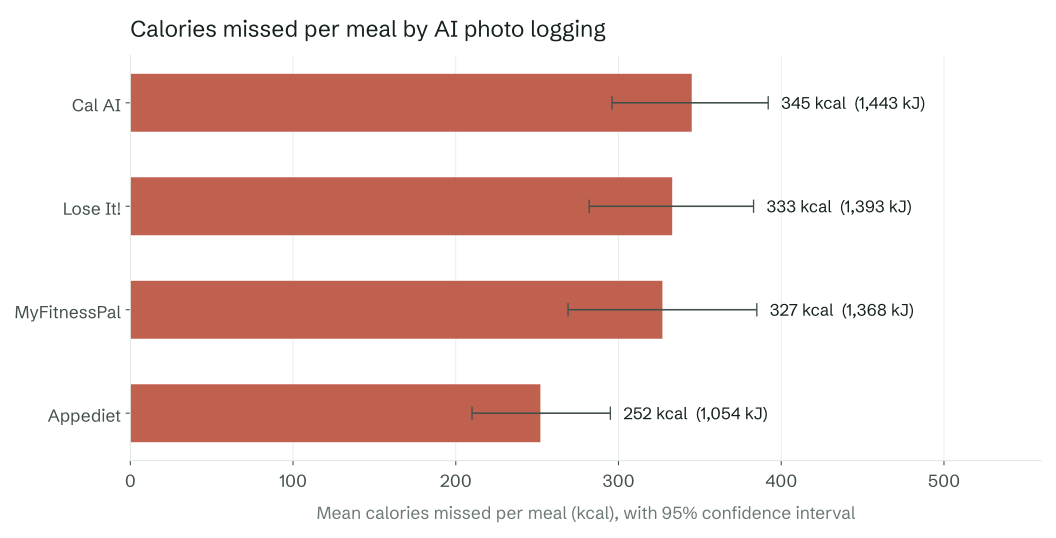
Two more details from the abstract. Lose It and MyFitnessPal were more accurate on higher-calorie meals than on lower-calorie ones. And carbohydrate was the closest estimate: two of the apps had no significant carbohydrate error, while Lose It and Cal AI were each about 14 g low.
#Most of the gap is fat
All four apps underestimated fat by about 30 grams per meal. Fat carries about 37 kJ (9 calories) per gram, so 30 g is roughly 1,100 kJ, or 270 calories. On its own, that's most of the gap.
It makes sense once you think about what a camera can see. It can see rice. It can't see the oil the rice was fried in, the butter melted into the vegetables, the dressing soaked into the salad or the cream in the sauce. Fat is dense, it's often absorbed into the food, and a little adds a lot.
A follow-up looking at more than 200 further meals suggests the miss gets bigger on higher-fat, lower-carbohydrate plates. That part is even more preliminary, but if you eat low-carb or keto, it describes exactly the food on your plate.
What 30 grams of fat looks like
About 33 mL of cooking oil, a little over one and a half Australian tablespoons. Across three main meals, a 30 g miss each time is roughly 3,300 kJ (810 calories) a day: more than the roughly 2,100 kJ (500 calorie) daily deficit commonly suggested for losing about half a kilo a week.
#Why a third matters more than it sounds
A wrong number you know about is manageable. The trouble here is that the error isn't random. Commenting on the study, Leigh Frame of George Washington University pointed out that the bias runs consistently one way, so it compounds day after day instead of cancelling out.
Take a day logged at 1,800 calories, three main meals by photo. If each meal were missed by the amounts in this study, the real total would be somewhere around 2,550 to 2,850. The test meals were fairly large, so treat that as an illustration rather than a forecast, but the direction is the point: the app says deficit, the body says maintenance.
That's the most common complaint in calorie tracking, I'm hitting my number and nothing's happening
, and it's often blamed on metabolism. Sometimes it's the log. (We've written about telling the two apart.)
The researchers also noted that a one-third undercount is similar to what's already seen when people self-report their diets. In other words, the camera hasn't removed the human error. It has swapped it for its own.
#Does that mean photo logging is useless?
No, and the study doesn't say so. It measured accuracy, not outcomes. Frame's view was that these apps are better thought of as behaviour-change tools than measuring instruments, and on that measure a fast, rough log you actually keep beats a precise one you abandon in week two. (That's most of the argument in do I have to log everything?)
The useful takeaway is narrower: the direction of the error is known. Photo estimates run low, mostly on fat. A known bias is one you can correct for.
#How to get a more honest number
1. Add the fat yourself. After the photo, add the oil, butter, dressing, cheese or sauce as its own item. That one habit targets the biggest error the study found.
2. Fix the portion. Hengist's advice was to adjust portions or enter amounts manually, because photo estimates tend to run low. If the app's serve looks small, it probably is.
3. Judge by the scale, not the app. If your log says deficit and your weekly average weight hasn't moved in three or four weeks, believe the scale. Adaptive apps like MacroFactor do this automatically, estimating your real expenditure from logged intake and your weight trend, so a consistent undercount gets absorbed into the maths. (More on how that works.)
4. Weigh something occasionally. Not every meal. Once in a while, weigh your usual breakfast or a pour of oil to recalibrate your eye. (Hand portions are a decent everyday substitute.)
5. Say how it was cooked. Fried in oil
, with butter
, creamy sauce
: the words carry the information the pixels don't.
Say “cooked in butter.” The camera can't see it.
Rekkon logs from a description, so the oil, the dressing and the second helping go in with the meal, by voice, in about five seconds.
Try Rekkon free
#Is voice logging any better?
Rekkon wasn't part of this study, and I'm not going to claim it would have won. Voice logging is self-report, and self-report undercounts too. We've written about exactly how much.
What describing a meal does do is give you a place to say the things a camera can't see. Chicken stir fry, cooked in a fair bit of oil, with a cup of rice
carries the fat. A photo of the same bowl doesn't. Whether you say it is still up to you; no tool fixes a forgotten snack.
The honest summary applies to every tracker, ours included: estimates are directionally useful, usually biased low, and best checked against your weight trend over weeks rather than trusted to the calorie.
#Common questions
Are AI calorie counting apps accurate?
Not precisely. In an NIH-led test presented at NUTRITION 2026, the AI photo features of Cal AI, MyFitnessPal, Lose It and Appediet all underestimated meal energy, by an average of 252 to 345 calories per meal, about a third of what was on the plate. They're useful for rough awareness rather than measurement.
Which AI calorie app is the most accurate?
In this test Appediet had the smallest average miss, 252 calories per meal, with MyFitnessPal, Lose It and Cal AI at 327, 333 and 345. But the confidence intervals overlap and the apps weren't compared head-to-head, so the useful conclusion is that all four undercounted by a large margin, and how you use the app matters more than which one.
Why do AI calorie apps underestimate?
Mostly fat. All four apps in the study underestimated fat by about 30 grams per meal, roughly 270 calories. Cooking oil, butter, dressings and sauces are hard or impossible to see in a photo, and portions also tend to be estimated low.
Is Cal AI accurate?
In this test, Cal AI's photo feature underestimated meals by an average of 345 calories (95% confidence interval 296 to 392), the largest average miss of the four, though the confidence intervals overlap and the apps weren't compared head-to-head. Our separate article on Cal AI covers earlier research on photo estimation.
How can I make photo calorie tracking more accurate?
Add cooking fats, dressings and sauces as separate items, correct portions that look small, weigh a usual meal occasionally to recalibrate, and judge your intake by your weight trend over three to four weeks rather than by the app's daily number.